The Odyssey (Homer's version)

The Odyssey is the Greek bard Homer’s sequel to the earlier story, The Iliad. Reading the two back to back helps deepen any understanding of the late Bronze Age while noting real differences in writing style, characters, and storyline.
Bronze Age insights emerge through both stories. Since Bronze Age cultures ruled in the Mediterranean, much has changed; but some things, not at all. Early in the story, we join suitors to the queen sipping wine from 'well fashioned’ and ‘finely crafted’ goblets, feasting on beef and pork, enjoying fresh bread at beautifully made tables on oxhide chairs, men laughing and storytelling. This first description of suitors at the palace could be describing any Mediterranean villa today. And yet, as in The Iliad, any day could be your last. The ruling social order was defined by dominance by the most physically and socially powerful.

While some characters return in the sequel, the stories are entirely different. The Iliad is about war, chronicling the final days of a 10-year siege. The Odyssey on the other hand describes the adventures of a single man, over many years, encountering gods, kings, beasts, witches, and even a visit to the underworld. The story defines the word ’odyssey’.
Equally different are literary characteristics. The Odyssey employs many more modern literary and story-telling tools that we appreciate today. Consider character development. The Iliad‘s character descriptions are limited to the externally contextual: ancestry, hometown, geography, previous military campaigns and other hints. The Odyssey describes characteristics from a far more human perspective. To set the stage, below are a few, beginning with main characters, set amongst palace intrigue, life on the farm, and defining moments of honor and deceit.
Odysseus was the king of Ithaca, a hardscrabble Greek island in the Ionian Sea, so wrought with stones that horses wouldn’t do well there. Odysseus had joined Agamemnon, the king of Mycenae, in a war to avenge the theft of Agamemnon’s brother’s wife. The brother is Menelaus, king of Sparta, and his wife, Helen. As in, the face that launched a thousand ships, Helen of Troy, the casus belli of the Trojan War. In the Iliad, our main character Odysseus was a great warrior, ‘a sacker of cities’ in his own right.
As the Odyssey opens, he had been away from Ithaca for ten years besieging Troy, plus another ten years getting home. Waiting patiently for him are his wife “prudent Penelope”, and their son Telemachus. A clear juxtaposition unfolds between Penelope and King Agamemnon’s wife, Klytemnestra. While Penelope waits ingloriously, patiently, honorably for her husband's return, Klytemnestra conspires with her lover to murder King Agamemnon at his homecoming dinner banquet. Good and evil, honor and dishonor, it's hard to miss the human element.
Meanwhile, over 100 suitors roost at Odysseus‘s palace, all with designs on bedding Penelope and ascending to become king of Ithaca.
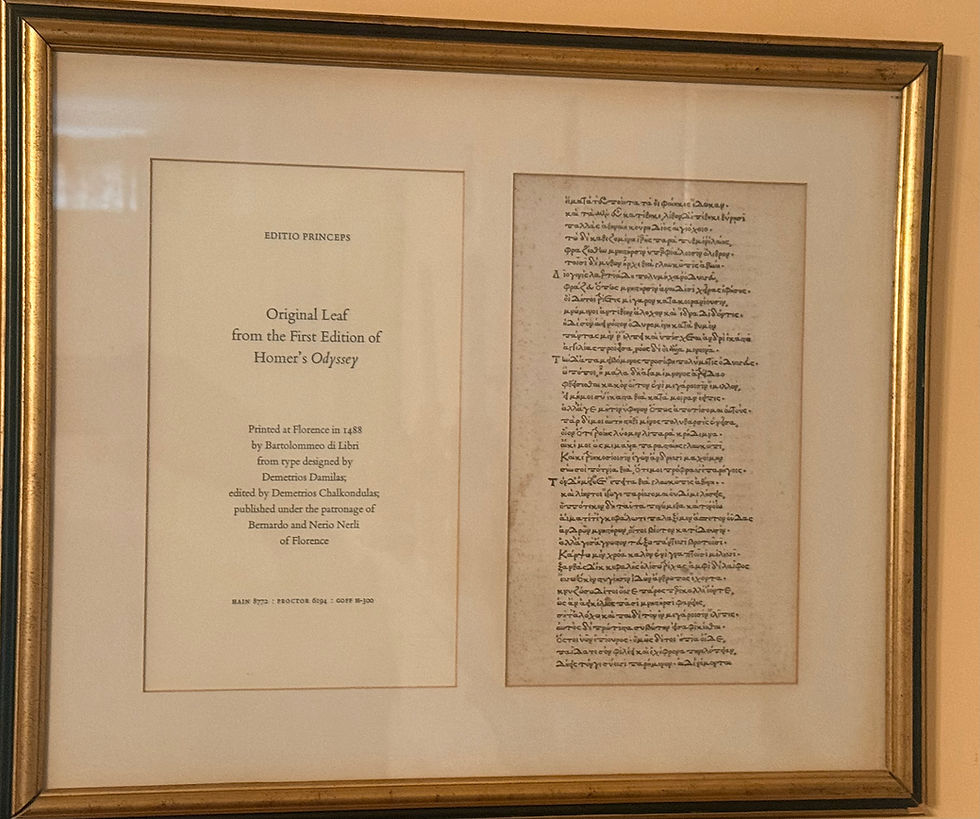
Foreshadowing is another literary technique from this earliest of written literature. Seven lines toward the end of Book 20 appear below, as Penelope considers the suitors draining the stores of her palace:
Ikarios’ prudent daughter Penelope had set down
her elegant chair, so it faced them: she could now hear
what each man was saying, they are in the hall. For while
they were laughing, they'd also been readying their dinner -
sweet and satisfying, since they’d slaughtered so many beasts.
Yet no more unpleasant supper could there have been
than the one that a goddess and a powerful man
would soon serve to those who started such vile misdeeds.
Here, the foreshadowing is overt. The story is not only about travel, pining for home, and periodic adventure; this will also be a story of vengeance.
Romanticism was a literary movement defining certain 19th century American writing, but patterns that define romanticism permeate Odysseus’s story frequently. Ogygia is a peaceful island paradise, with sweet aromas, green woodlands, and a host of sensual descriptions where Calypso, the “nymph with the lovely braids” lives. She offers Odysseus immortality if he remains in her bed. He does remain, for seven years, addled by lotus flowers that impair all memories of his wife, his crewmen, and his home. Odysseus’ love for Penelope is so pure however, that Calypso can never take his whole heart. Eventually, the gods intercede: Athene, Odysseus’ main goddess protector, petitions Zeus for Calypso to release Odysseus. Zeus dispatches Hermes the Messenger who instructs Calypso to release Odysseus. She allows him these latent memories of home, lets him make a raft from his ship’s remains, and even blesses him with a following wind.
Another island nymph, Circe, magically converts men to animals, but Odysseus had been warned by the Messenger Hermes not to touch her wand, to challenge her with his sword, and to force an oath of non-aggression before accepting her bed. She too comes around and permits his release and uncurses his magically transformed crewmen back from swines. She also helps Odysseus significantly more than jealous Calyso had, offering important instructions to get home: go to Hades, the underworld, discover why his journey home has been so difficult, whom to seek out, and listen for what he still needs to do.
The Odyssey also exposes Bronze Age power dynamics as Odysseus island-hops, alternatively as a guest welcomed and a warrior unwelcome. Hellenistic city states had not congealed into a nation such as we think of countries today; people were ruled by the dominant family in fortress enclaves. Host kings who recognized Odysseus as royalty would treat him to feasts, provide new clothes, proffer other gifts, and offer advice for his journey. A different and opposing force reflecting Bronze Age lore, monsters like the cyclops Polyphemus or giant Lystregonians, the alluring nymphs Calypso and Circe, and the lovely seductive Sirens, all impeded Odysseus’ journey home. Not to mention powerful Poseidon, brother of Zeus, and Lord of the Sea.
The gods of Mount Olympus are active throughout the story, as in the Iliad, reflective of the time’s polytheism. A central theme begins with a simple effort to gather food when the crew is met, and held prisoner, by the giant Cyclops. They blind the Cyclops to escape his cave lair, but we learn the Cyclops is the son of ‘earth shaker’ Poseidon (also god of the sea). This early misadventure sets powerful Poseidon, Zeus’s brother, against Odysseus for the rest of the story. Athene on the other hand was an enduring advocate, protector, and provider to Odysseus. Appealing to gods through sacrifice, and prayer was expected, and performed with purpose and respect.
Another storytelling technique: the confluence of several sub-plots, stories from different places, as the story begins its conclusion. The late books eventually bring Odysseus together with his son Telemachus, as son searches for father at Sparta and Pylos. Meanwhile, back in Ithaca, Penelope continues to resist the suitors who have moved into her palace, uncertain of her son’s safety and unaware of her husband’s imminent return. As these plots converge, revenge becomes the dominant theme. The foreshadowing upon us, the Odyssey resolves as a story of vengeance.
To read such a story with such cultural insight today is to remind us how fleeting our world views can be. In these stories, to be rich was to be successful at plunder. Odysseus‘s father Laertes’ epithet was also ‘Sacker of Cities’. Achilles, Agamemnon, Menelaos, and others were ‘godlike’ as killing machines . And clever: ‘resourceful Odysseus’ is a repeating epithet. To sack a city was to win in battle: Kill all the military aged men, take the women and skilled children into slavery. Power aggregated to the physically, socially, and mentally dominant.
There are lessons for us today. For most of humanity, that is, since the Bronze Age power has been derived from coercion, from violence. Roughly three quarters of humanity today is ruled by autocratic governments. Our society here is an aberration, founded on the disaggregation of state power and the sanctity of individual property. This social experiment has powered innovation that benefits all people. More citizens have agency, arts thrive, people can pursue dreams. Cooperation and collaboration shed less blood and create more cauldrons and tripods and bars of gold than plunder ever did or ever will.
Post-movie comments, because we saw the movie right after finishing Homer’s story:
The movie was great. The story in the movie followed the plotline well, its imagery spectacular, even the length was OK. After all, Odysseus was away from home for 20 years. A few points did emerge, so skip these if you don’t want a spoiler, or to have too much revealed.
The movie ended with a disappointing revision, while Homer’s ending remained true to the rest of the story. In Homer’s version of the palace slaughter, Odysseus was joined by his son Telemachus, the loyal swineherd Eumaeus, and a loyal cowherd Philoetius. No suitors survived. (Many surrendered in the movie). Only Plemius (the bard, singing for the suitors under duress) and Medon (the herald, loyal to Telemachus) were spared. After the slaughter, twelve handmaidens who had been sleeping with suitors, disrespecting Penelope, had to clean the massacre’s blood and gore, and then were hanged. The morning after the slaughter, Odysseus and Telemachus visit Laertes, Odysseus’ father. When family members of the killed suitors arrive to exact their own revenge, they all engage in another battle. Once a handful of the suitors’ family members are killed, Athene intervenes to stop further carnage; her advice, to mend broken bonds, to re-establish order. This done, Odysseus remains King of Ithaca, and lives a long life as prophesied. In the movie, he and Penelope simply sail into the sunset. Homer’s message was one of peace through strength and restraint; the movie ended in retreat, albeit with beautiful cinematic colors.
Another detail was Helen. After Troy, Menelaos brought Helen home; and the book gave no implication of mistreatment. She does confide to Telemachus, in both, her sadness for having been the catalyst for the war, the death, and all the family losses. In the movie, she bears a facial scar, compromising her beauty; viewers to infer abuse of some kind. No scar would mar the face of a goddess.
A final Nolan add-on toward the end, while Odysseus spoke with Penelope, disguised as a war veteran: he lamented how the Achaians (Greeks) had offered the horse as a peace offering, how the horse was actually a ruse. This ruse violated a civilizational bond, prophesying dark times ahead. For historical reality, think “All’s fair in love and war”. Odysseus never regretted sacking Troy. It’s what he did, who he was. And in the Bronze Age, that made him a legend.
Comments